About Half the World's Population Speaks a Language That Is Part of the Indo-european Family.
The Indo-European languages are a family of related languages that today are widely spoken in the Americas, Europe, and as well Western and Southern Asia. Simply as languages such as Spanish, French, Portuguese and Italian are all descended from Latin, Indo-European languages are believed to derive from a hypothetical language known as Proto-Indo-European, which is no longer spoken.
Information technology is highly probable that the earliest speakers of this language originally lived around Ukraine and neighbouring regions in the Caucasus and Southern Russia, and so spread to most of the rest of Europe and later down into India. The earliest possible end of Proto-Indo-European linguistic unity is believed to be effectually 3400 BCE.
Since the speakers of the Proto-Indo-European linguistic communication did not develop a writing system, we have no physical bear witness of information technology. The scientific discipline of linguistics has been trying to reconstruct the Proto-Indo-European language using several methods and, although an accurate reconstruction of information technology seems impossible, nosotros accept today a general moving-picture show of what Proto-Indo-European speakers had in common, both linguistically and culturally. In addition to the use of comparative methods, in that location are studies based on the comparison of myths, laws, and social institutions.
The ancients came up with the explanation that the Latin language was a descendant of the Greek linguistic communication.
Branches of Indo-European Languages
The Indo-European languages have a large number of branches: Anatolian, Indo-Iranian, Greek, Italic, Celtic, Germanic, Armenian, Tocharian, Balto-Slavic and Albanian.
Anatolian
This branch of languages was predominant in the Asian portion of Turkey and some areas in northern Syrian arab republic. The almost famous of these languages is Hittite. In 1906 CE, a large corporeality of Hittite finds were made on the site of Hattusas, the capital of the Hittite Kingdom, where about 10,000 cuneiform tablets and various other fragments were institute in the remains of a royal archive. These texts engagement back to the mid to late 2nd millennium BCE. Luvian, Palaic, Lycian, and Lydian are other examples of families belonging to this group.
All languages of this branch are currently extinct. This branch has the oldest surviving evidence of an Indo-European linguistic communication, dated nearly 1800 BCE.
Indo-Iranian
This branch includes ii sub-branches: Indic and Iranian. Today these languages are predominant in India, Pakistan, Iran, and its vicinity and likewise in areas from the Black Bounding main to western China.
Sanskrit, which belongs to the Indic sub-branch, is the all-time known among the early on languages of this branch; its oldest variety, Vedic Sanskrit, is preserved in the Vedas, a collection of hymns and other religious texts of ancient Bharat. Indic speakers entered into the Indian subcontinent, coming from central Asia around 1500 BCE: In the Rig-Veda, the hymn one.131 speaks about a legendary journey that may be considered a distant memory of this migration.
Avestan is a linguistic communication that forms part of the Iranian grouping. Old Avestan (sometimes chosen Gathic Avestan) is the oldest preserved language of the Iranian sub-branch, the "sis" of Sanskrit, which is the language used in the early Zoroastrian religious texts. Another important language of the Iranian sub-branch is Erstwhile Persian, which is the language plant in the royal inscriptions of the Achaemenid dynasty, starting in the late 6th century BCE. The earliest datable bear witness of this branch dates back to nigh 1300 BCE.
Today, many Indic languages are spoken in India and Pakistan, such every bit Hindi-Urdu, Punjabi, and Bengali. Iranian languages such as Farsi (mod Farsi), Pashto, and Kurdish are spoken in Iraq, Iran, Afghanistan, and Tajikistan.

Indo-European language family tree
Greek
Rather than a co-operative of languages, Greek is a group of dialects: During more than 3000 years of written history, Greek dialects never evolved into mutually incomprehensible languages. Greek was predominant in the southern end of the Balkans, the Peloponnese peninsula, and the Aegean Sea and its vicinity. The earliest surviving written bear witness of a Greek linguistic communication is Mycenaean, the dialect of the Mycenaean civilization, mainly found on clay tablets and ceramic vessels on the island of Crete. Mycenaean did non have an alphabetic written system, rather it had a syllabic script known as the Linear B script.
The first alphabetic inscriptions have been dated dorsum to the early 8th century BCE, which is probably the time when the Homeric epics, the Iliad and the Odyssey, reached their present form. At that place were many Greek dialects in ancient times, only considering of Athens cultural supremacy in the 5th century BCE, it was the Athens dialect, chosen Attic, the one that became the standard literary language during the Classical menstruum (480-323 BCE). Therefore, the nigh famous Greek poetry and prose written in Classical times were written in Cranium: Aristophanes, Aristotle, Euripides, and Plato are only a few examples of authors who wrote in Attic.
Italic
This co-operative was predominant in the Italian peninsula. The Italic people were not natives of Italy; they entered Italy crossing the Alps around 1000 BCE and gradually moved due south. Latin, the most famous language in this grouping, was originally a relatively minor local language spoken by pastoral tribes living in small agronomical settlements in the centre of the Italian peninsula. The start inscriptions in Latin appeared in the 7th century BCE and by the 6th century BCE it had spread significantly.
Rome was responsible for the growth of Latin in ancient times. Classical Latin is the grade of Latin used by the well-nigh famous works of Roman authors like Ovid, Cicero, Seneca, Pliny, and Marcus Aurelius. Other languages of this co-operative are: Faliscan, Sabellic, Umbrian, South Picene, and Oscan, all of them extinct.
Today Romance languages are the merely surviving descendants of the Italic branch.
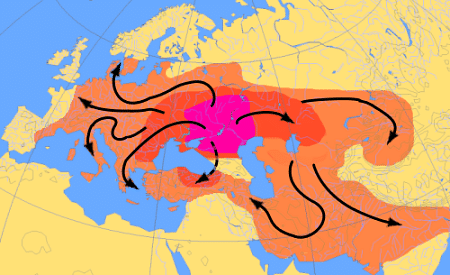
Map of Indo-Euopean Migrations
Celtic
This branch contains two sub-branches: Continental Celtic and Insular Celtic. Past about 600 BCE, Celtic-speaking tribes had spread from what today are southern Germany, Republic of austria, and Western Czech Republic in virtually all directions, to France, Kingdom of belgium, Spain, and the British Isles, and so by 400 BCE, they besides moved south into northern Italy and southeast into the Balkans and even beyond. During the early 1st century BCE, Celtic-speaking tribes dominated a very significant portion of Europe. On 50 BCE, Julius Caesar conquered Gaul (ancient France) and Britain was also conquered about a century later by the emperor Claudius. Equally a result, this large Celtic-speaking area was captivated by Rome, Latin became the ascendant language, and the Continental Celtic languages somewhen died out. The main Continental language was Gaulish.
Insular Celtic adult in the British Isles after Celtic-speaking tribes entered around the sixth century BCE. In Ireland, Insular Celtic flourished, aided by the geographical isolation which kept Republic of ireland relatively prophylactic from the Roman and Anglo-Saxon invasion.
The only Celtic languages yet spoken today (Irish gaelic Gaelic, Scottish Gaelic, Welsh and Breton) all come up from Insular Celtic.
Germanic
The Germanic branch is divided in three sub-branches: East Germanic, currently extinct; North Germanic, containing Erstwhile Norse, the antecedent of all modern Scandinavian languages; and West Germanic, containing Sometime English, Old Saxon, and Old Loftier German.
The earliest evidence of Germanic-speaking people dates back to first half of the 1st millennium BCE, and they lived in an expanse stretching from southern Scandinavia to the declension of the Due north Baltic Sea. During prehistoric times, the Germanic speaking tribes came into contact with Finnic speakers in the north and also with Balto-Slavic tribes in the due east. As a upshot of this interaction, the Germanic language borrowed several terms from Finnish and Balto-Slavic.
Several varieties of Old Norse were spoken past most Vikings. Native Nordic pre-Christian Germanic mythology and folklore has been as well preserved in Old Norse, in a dialect named Onetime Icelandic.
Dutch, English, Frisian, and Yiddish are some examples of modern survivors of the West Germanic sub-branch, while Danish, Faeroese, Icelandic, Norwegian, and Swedish are survivors of the North Germanic branch.
Armenian
The origins of the Armenian-speaking people is a topic all the same unresolved. It is probable that the Armenians and the Phrygians belonged to the same migratory wave that entered Anatolia, coming from the Balkans around the belatedly second millennium BCE. The Armenians settled in an area around Lake Van, currently Turkey; this region belonged to the state of Urartu during the early 1st millennium BCE. In the 8th century BCE, Urartu came under Assyrian control and in the 7th century BCE, the Armenians took over the region. The Medes absorbed the region soon subsequently and Armenia became a vassal state. During the time of the Achaemenid Empire, the region turned into a Persian satrap. The Farsi domination had a strong linguistic impact on Armenian, which mislead many scholars in the by to believe that Armenian actually belonged to the Iranian group.
Tocharian
The history of the Tocharian-speaking people is still surrounded past mystery. Nosotros know that they lived in the Taklamakan Desert, located in western China. Almost of the Tocharian texts left are translations from well-known Buddhist works, and all of these texts have been dated between the 6th and the eighth centuries CE. None of these texts speak about the Tocharians themselves. Two dissimilar languages belong to this branch: Tocharian A and Tocharian B. Remains of the Tocharian A language accept merely been constitute in places where Tocharian B documents take also been found, which would suggest that Tocharian A was already extinct, kept alive only as a religious or poetic language, while Tocharian B was the living language used for authoritative purposes.
Many well-preserved mummies with Caucasoid features such every bit tall stature, crimson, blonde, and brown hair, accept been discovered in the Taklamakan Desert, dating between 1800 BCE to 200 CE. The weaving style and patterns of their clothes is similar to the Hallstatt civilization in central Europe. Concrete assay and genetic prove have revealed resemblances with the inhabitants of western Eurasia.
This branch is completely extinct. Amid all ancient Indo-European languages, Tocharian was spoken uttermost to the eastward.
Balto-Slavic
This branch contains two sub-branches: Baltic and Slavic.
During the belatedly Bronze Historic period, the Balts' territory may have stretched from around western Poland all the style across to the Ural Mountains. Afterwards, the Balts occupied a small region along the Baltic Sea. Those in the northern part of the territory occupied by the Balts were in close contact with Finnic tribes, whose language was not part of the Indo-European language family unit: Finnic speakers borrowed a considerable corporeality of Baltic words, which suggests that the Balts had an important cultural prestige in that surface area. Under the force per unit area of Gothic and Slavic migrations, the territory of the Balts was reduced towards the 5th century CE.
Archaeological testify shows that from 1500 BCE, either the Slavs or their ancestors occupied an surface area stretching from near the western Smooth borders towards the Dnieper River in Belarus. During the sixth century CE, the Slav-speaking tribes expanded their territory, migrating into Hellenic republic and the Balkans: this is when they are mentioned for the first time, in Byzantine records referring to this large migration. Either some or all of the Slavs were one time located farther to the east, in or around Iranian territory, since many Iranian words were borrowed into pre-Slavic at an early on phase. After, every bit they moved west, they came into contact with German tribes and once again borrowed several additional terms.
Just two Baltic languages survive today: Latvian and Lithuanian. A large number of Slavic languages survive today, such as Bulgarian, Czech, Croation, Polish, Serbian, Slovak, Russian, and many others.
Albanian
Albanian is the terminal branch of Indo-European languages to appear in written form. There are 2 hypotheses on the origin of Albanian. The first one says that Albanian is a modern descendant of Illyrian, a linguistic communication which was widely spoken in the region during classical times. Since we know very little about Illyrian, this assertion tin be neither denied nor confirmed from a linguistic standpoint. From a historical and geographical perspective, notwithstanding, this assertion makes sense. Another hypotheses says that Albanian is a descendant of Thracian, some other lost language that was spoken farther east than Illyrian.
Today Albanian is spoken in Albania as the official language, in several other areas in of the former Yugoslavia and also in minor enclaves in southern Italy, Hellenic republic and the Democracy of Macedonia.
Unaffiliated Languages
All languages in this group are either extinct or they are a former stage of a modern linguistic communication. Examples of this groups of languages are Phrygian, Thracian, Ancient Macedonian (not to be confused with Macedonian, a language currently spoken in the Republic of Macedonia, part of the Slavic branch), Illyrian, Venetic, Messapic, and Lusitanian.
Indo-European Historical Linguistics
In aboriginal times information technology was noticed that some languages presented hitting similarities: Greek and Latin are a well-known example. During classical artifact it was noted, for example, that Greek héks "vi" and heptá "seven" were similar to the Latin sexual activity and septem. Furthermore, the regular correspondence of the initial h- in Greek to the initial s- in Latin was pointed out.
The caption that the ancients came up with was that the Latin language was a descendant of Greek linguistic communication. Centuries afterward, during and after the Renaissance, the close similarities betwixt more languages were also noted, and it was understood that sure groups of languages were related, such as Icelandic and English language, and also the Romance languages. Despite all of these observations, the science of linguistics did not develop much further until the 18th century CE.
During the British colonial expansion into Bharat, a British orientalist and jurist named Sir William Jones became familiar with the Sanskrit language. Jones was as well knowledgeable in Greek and Latin and was surprised past the similarities between these 3 languages. During a lecture on February 2, 1786 CE, Sir William Jones expressed his new ideas:
The Sanskrit language, whatever exist its artifact, is of a wonderful construction; more perfect than the Greek, more copious than the Latin, and more exquisitely refined than either, yet bearing to both of them a stronger affinity, both in the roots of verbs and the forms of grammar, than could perhaps have been produced by blow; and then strong indeed, that no philologer could examine them all three, without assertive them to take sprung from some common source, which, mayhap, no longer exists; there is a similar reason, though not quite and so forcible, for supposing that both the Gothic and the Celtic, though blended with a very different idiom, had the same origin with the Sanskrit; and the sometime Persian might be added to the same family, if this were the identify for discussing any question concerning the antiquity of Persia. (Fortson, p. 9)
The idea that Greek, Latin, Sanskrit, and Persian were derived from a common source was revolutionary at that time. This was a turning point in the history of linguistics. Rather than the "daughter" of Greek, Latin was for the offset fourth dimension understood as the "sister" of Greek. By becoming familiar with Sanskrit, a linguistic communication geographically far removed from Greek and Latin, and realizing that chance was an insufficient explanation for the similarities between these languages, Sir William Jones presented a new insight which triggered the evolution of modern linguistics.
This article has been reviewed for accuracy, reliability and adherence to academic standards prior to publication.
Source: https://www.worldhistory.org/Indo-European_Languages/
0 Response to "About Half the World's Population Speaks a Language That Is Part of the Indo-european Family."
Publicar un comentario