Judith Leyster Self Portrait Allegory of the Art of Painting Jan Vermeer
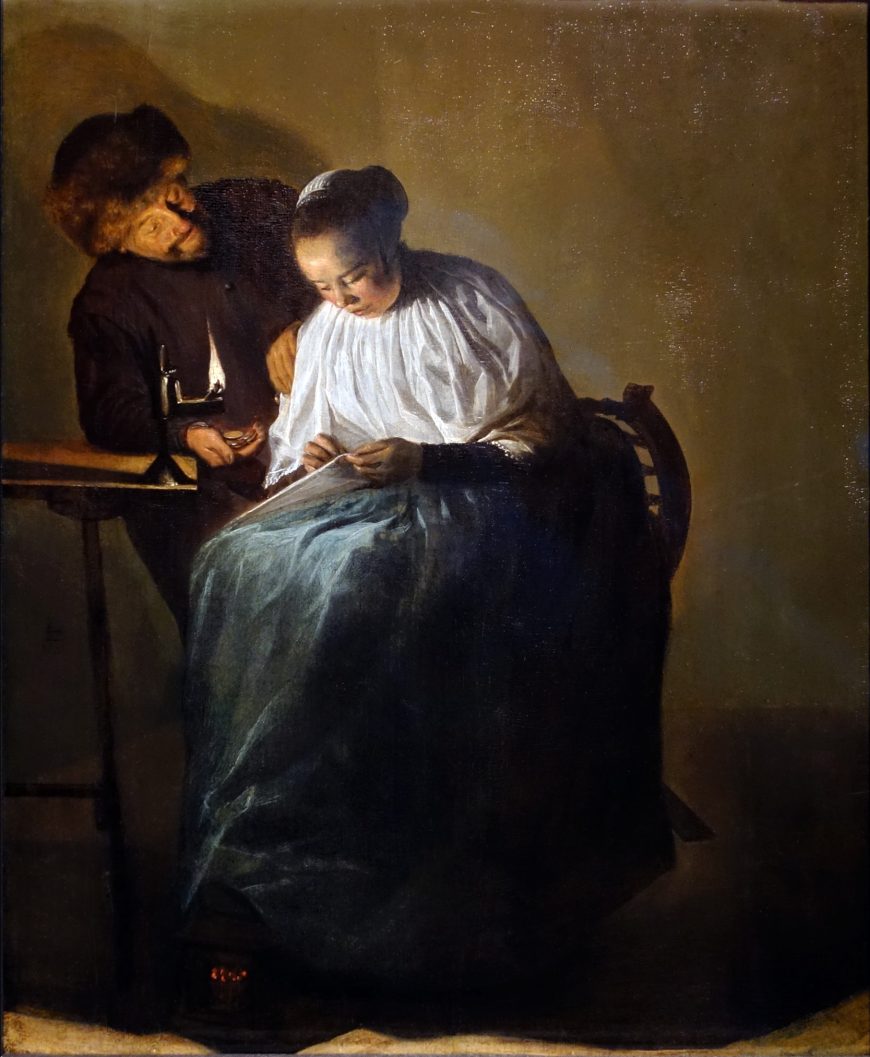
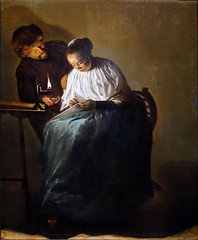
Judith Leyster,Man Offer Money to a Woman ( The Proffer), 1631, oil on console, 11-iii/8 × 9-one/ii inches (Mauritshuis, The Hague)
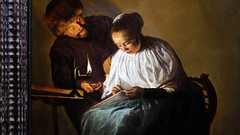
A soberly dressed woman sits in a darkened room, working diligently on her sewing. The only low-cal comes from a lamp on the table, filling the room with deep, ominous shadow. An older man in a fur lid touches her shoulder with one hand and with the other presents a fistful of coins. The sparsely lit and furnished room and the man's leering countenance generate a sense of unease; the suspended moment leaves the viewer uncomfortable with what has happened—or what is near to transpire. But who are these people? What will the woman choose: to do her work and ignore the man, or to put down her sewing to take the money? Virtue or vice?
Judith Leyster's painting, called Human being Offering Money to a Woman past the Mauritshuis Museum merely frequently referred to every bit The Proposition, is an enigmatic painting with an ambiguous subject field. Painted by 1 of the few well-known female artists working in the Dutch Republic, its field of study matter is unusual in Dutch fine art, though it has strong ties to several visual and symbolic traditions. Its diminutive size—a mere thirty.8 by 24.ii centimeters—invites the viewer to examine it carefully and intimately.
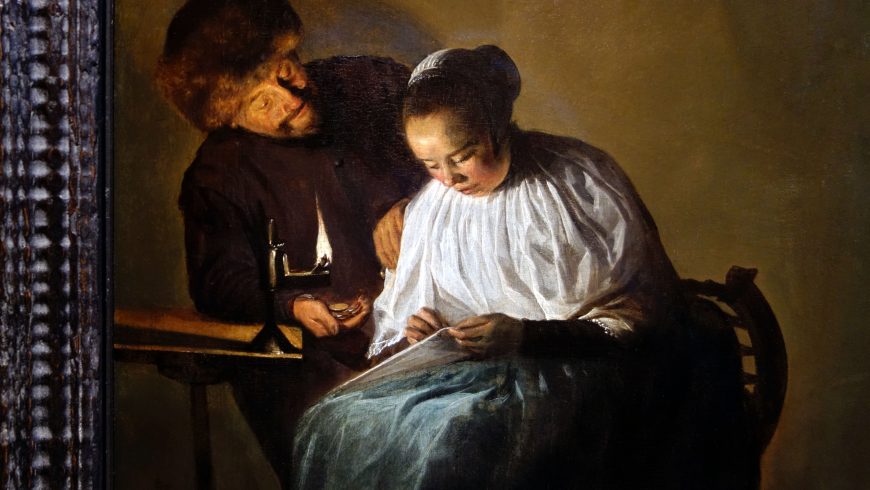
Detail, Judith Leyster, Man Offering Money to a Woman (The Suggestion), 1631, oil on panel, xi-3/8 × nine-ane/2 inches (Mauritshuis, The Hague)
Leyster, Haarlem, and Caravaggio
Judith Leyster lived and worked primarily in the Dutch city of Haarlem, one of the centers of artistic innovation in the showtime one-half of the seventeenth century. The city had benefitted from an influx of artists and artisans who fled Antwerp in the Spanish Netherlands (now Belgium) during the 80 Years State of war. Leyster was a member of the Lodge of St. Luke (the guild for painters and several other trades), which was unusual for a woman. Like many of her colleagues including Frans Hals, Dirck Hals, and Pieter Codde, she primarily painted scenes of everyday people doing everyday things (otherwise known as genre scenes). Her work is distinctive for the flat background that gives footling sense of an illusionistic interior space. Some scholars have attributed this to her possible contact with the "Utrecht School"—artists in the Dutch city of Utrecht who were influenced past Caravaggio whose early genre scenes such as The Cardsharps (beneath) display similarly flat backgrounds with figures close to the viewer. The sharp contrasts of calorie-free and dark on the woman'southward blouse and face are also reminiscent of Caravaggio. There are just two visible light sources, the lamp on the table and the glowing foot warmer under the adult female'southward feet. The flame in the lamp is a form of illumination oft seen in Caravaggio'southward northern followers (and not in Caravaggio's ain piece of work).
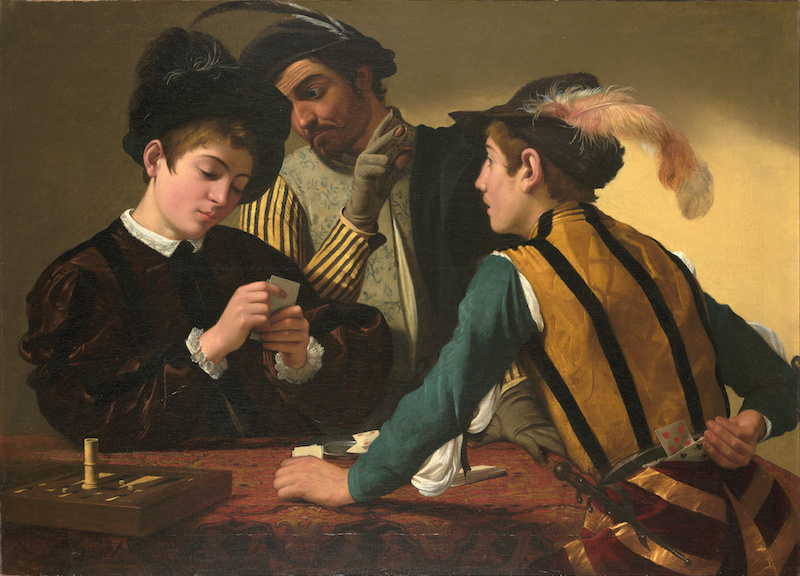
Caravaggio, The Cardsharps, c. 1595, oil on canvas, 37 1/16 ten 51 9/16 inches / 94.ii ten 130.9 cm (Kimbell Art Museum)
Instilling morality
On the surface, the painting shows an bad-mannered interaction betwixt a human and a woman. Dutch art often seems to reverberate everyday life. Nevertheless there are reasons to interpret these images symbolically, and not just as a reflection of life as it was lived. Some scholars (including Wayne Franits and Simon Schama), have interpreted the immense volume of imagery of women as indicative of a general anxiety about women'southward instruction and what information technology meant to be a expert Calvinist housewife. Since religious art was not beingness produced for the church in this Protestant land, morality had to be instilled in other ways. Secular genre scenes are oftentimes perceived as having a role to play in the moral teaching of the populace, either in presenting an image of ideal behavior or the consequences of bad behavior. Scenes of pious, moral women on the i hand and brothel scenes with lascivious women on the other may have flourished for just these reasons.
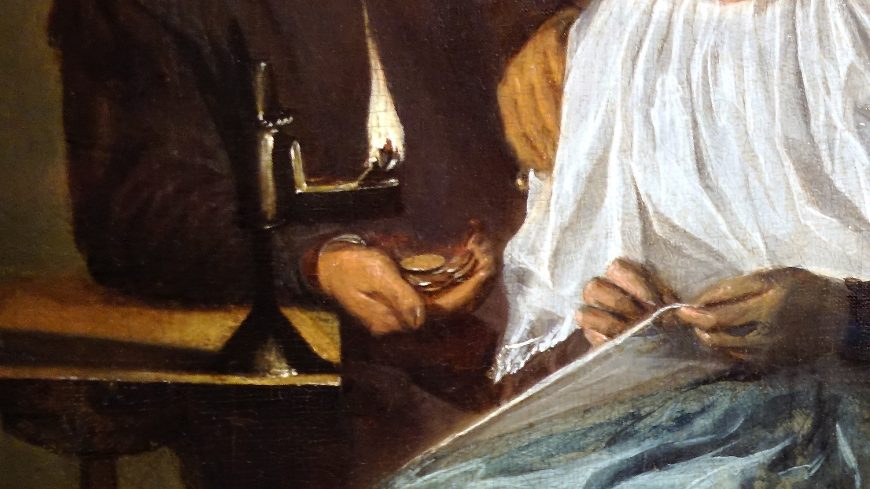
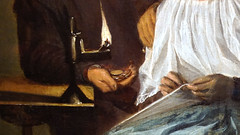
Hands (detail), Judith Leyster, Man Offering Money to a Woman (The Proposition), 1631, oil on panel, eleven-three/eight × 9-1/2 inches (Mauritshuis, The Hague)
Ane usually accepted interpretation of this painting—and the one from which the painting takes its most common nickname—was proposed by a leading scholar who sees the painting as representing a sexual suggestion—one which the woman is staunchly ignoring.[1] This is a novel take on a traditional subject—brothel scenes where men interact with prostitutes or men and women drink and make merry in mixed visitor were among the nearly common subjects for genre paintings of the early seventeenth century. This blazon of scene has a long history in northern fine art (by artists such as Quentin Metsys, Lucas Cranach, Albrecht Durer, and others) and the deportment of the participants was presented every bit unwise, unrestrained, and sinful, and women are ordinarily presented equally seductresses and thieves. These paintings therefore are models of how not to carry. By contrast, Leyster's limerick draws on another type of imagery that showed women difficult at piece of work—the very model of virtue.
Keepsake books
A common component of visual culture in the seventeenth century was a blazon of book called an emblem book. On one folio, the book might comprise an image, a motto, and a verse form, all explaining ane moral lesson the reader was expected to learn. Books of this sort proliferated and some scholars have noted that in that location were more than copies of keepsake books circulating in seventeenth century Holland than bibles. Many scholars have tried to use this shared visual linguistic communication to "decode" the components of genre paintings, with mixed success. Emblem literature was often targeted at specific audiences: for instance, Jacob Cats,Houwelijk (Marriage) outlined all the proper stages of life for a woman. In one emblem, he presents needlework as 1 of the skills most valued and emblematic of domestic virtue.
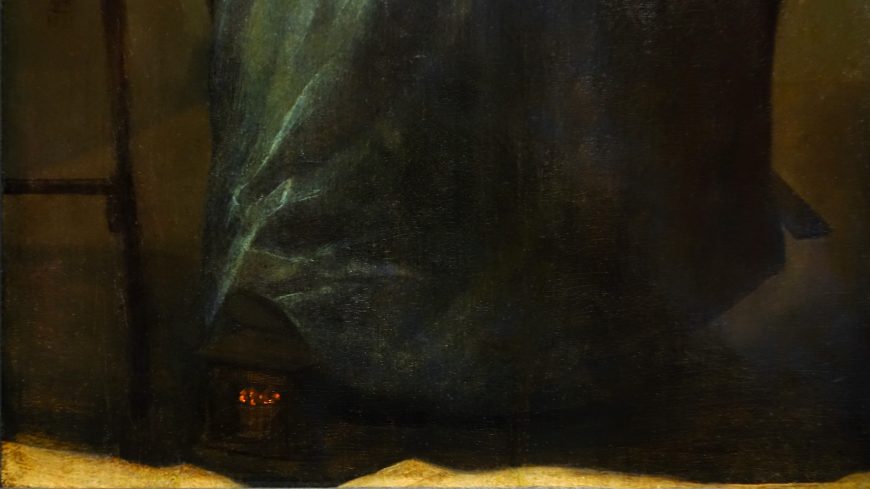
Pes warmer (detail), Judith Leyster, Human being Offer Coin to a Adult female (The Suggestion), 1631, oil on console, 11-3/eight × 9-one/two inches (Mauritshuis, The Hague)
In Leyster's painting, the woman becomes an icon of domesticity, working diligently in the common cold, unlit room. Fifty-fifty the foot warmer on which the adult female rests her feet to combat the cold has been continued to emblem books—as a symbol of the adult female'southward refusal of the man. One keepsake book frames the human foot warmer as a woman'southward all-time friend since a man would have to be truly enticing to become a woman to step away from her foot warmer on a cold night. The woman's firmly planted foot does not indicate a tendency towards a sexual liaison. Leyster's limerick has been seen every bit an important fore-runner of afterwards genre painters such as Gerard Ter Borch, and, most famously, Johannes Vermeer. In Leyster's painting, the viewer is left wondering to which tradition the woman belongs. Like much of Dutch art of the Golden Age (the 17th century), this painting is nearly choices: the choices of the subjects and by extension, the choices of the viewer. The woman is in a suspended state, a moment of decision. Will she virtuously proceed her work, or arise, have the money, and go with the man? Volition she cull virtue or vice?
[one] Frima Fox Hofrichter, Judith Leyster: A Woman Painter in Holland's Gold Age (Davaco Publishers, 1989)
Smarthistory images for education and learning:
More Smarthistory images…
Boosted resource:
This painting at the Mauritshuis
Judith Leyster at the National Gallery of Art
Leyster on the Google Art Project
Wayne Fronts, Looking at Seventeenth-Century Dutch Fine art: Realism Reconsidered (Cambridge University Press, 1998).
Frima Fox Hofrichter, Judith Leyster: A Adult female Painter in Holland'southward Golden Age (Davaco Publishers, 1989).
Simon Schama, The Embarrassment of Riches: An Interpretation of Dutch Civilisation in the Gilded Historic period (Vintage, 1997).
Peter Schjeldahl, "A Woman's Work: The brief career of Judith Leyster," The New Yorker, June 29, 2009.
Source: https://smarthistory.org/leyster-proposition/
0 Response to "Judith Leyster Self Portrait Allegory of the Art of Painting Jan Vermeer"
Publicar un comentario