3rd Grade Reading Standard About Facts and Opinions
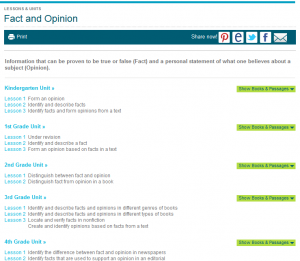 Information that tin exist proven to be true or false (Fact) and a personal argument of what i believes almost a subject (Opinion).
Fact and Opinion - Covers kindergarten through sixth form. Examples: Identify facts and course opinions from a text. Distinguish between fact and opinion. Locate and verify facts in nonfiction. Create and identify opinions based on facts from a text. Identify facts that are used to support an opinion in an editorial.
Central Ideas and Details
CCSS.ELA-Literacy.RI.K.2 With prompting and support, identify the main topic and retell key details of a text.
Integration of Knowledge and Ideas
CCSS.ELA-Literacy.RI.One thousand.7 With prompting and support, describe the relationship between illustrations and the text in which they announced (east.yard., what person, identify, affair, or idea in the text an illustration depicts).
CCSS.ELA-Literacy.RI.K.8 With prompting and support, identify the reasons an author gives to support points in a text.
Text Types and Purposes
CCSS.ELA-Literacy.Due west.M.1 Use a combination of drawing, dictating, and writing to compose opinion pieces in which they tell a reader the topic or the name of the volume they are writing about and state an stance or preference about the topic or book (east.g., My favorite volume is . . .).
Key Ideas and Details
CCSS.ELA-Literacy.RI.1.1 Ask and answer questions about key details in a text.
CCSS.ELA-Literacy.RI.1.2 Identify the main topic and retell fundamental details of a text.
Arts and crafts and Construction
CCSS.ELA-Literacy.RI.i.6 Distinguish between information provided by pictures or other illustrations and data provided past the words in a text.
Integration of Knowledge and Ideas
CCSS.ELA-Literacy.RI.one.7 Use the illustrations and details in a text to describe its key ideas.
CCSS.ELA-Literacy.RI.1.eight Identify the reasons an author gives to support points in a text.
Fundamental Ideas and Details
CCSS.ELA-Literacy.RI.ii.1 Ask and answer such questions as who, what, where, when, why, and how to demonstrate understanding of key details in a text.
CCSS.ELA-Literacy.RI.2.2 Identify the master topic of a multiparagraph text as well as the focus of specific paragraphs within the text.
Craft and Structure
CCSS.ELA-Literacy.RI.2.four Determine the meaning of words and phrases in a text relevant to a course 2 topic or discipline surface area.
Integration of Knowledge and Ideas
CCSS.ELA-Literacy.RI.2.8 Describe how reasons support specific points the writer makes in a text.
Key Ideas and Details
CCSS.ELA-Literacy.RI.3.i Ask and answer questions to demonstrate agreement of a text, referring explicitly to the text as the basis for the answers.
CCSS.ELA-Literacy.RI.3.2 Decide the main idea of a text; recount the central details and explain how they back up the chief idea.
Text Types and Purposes
CCSS.ELA-Literacy.W.iii.i Write opinion pieces on topics or texts, supporting a signal of view with reasons.
CCSS.ELA-Literacy.W.iii.1a Introduce the topic or text they are writing almost, country an opinion, and create an organizational structure that lists reasons.
CCSS.ELA-Literacy.W.3.1b Provide reasons that support the stance.
CCSS.ELA-Literacy.W.3.1c Use linking words and phrases (e.g., because, therefore, since, for example) to connect stance and reasons.
Comprehension and Collaboration
CCSS.ELA-Literacy.SL.3.2 Determine the main ideas and supporting details of a text read aloud or information presented in various media and formats, including visually, quantitatively, and orally.
Cardinal Ideas and Details
CCSS.ELA-Literacy.RI.4.ane Refer to details and examples in a text when explaining what the text says explicitly and when drawing inferences from the text.
CCSS.ELA-Literacy.RI.four.2 Determine the main idea of a text and explain how information technology is supported past key details; summarize the text.
CCSS.ELA-Literacy.RI.4.iii Explain events, procedures, ideas, or concepts in a historical, scientific, or technical text, including what happened and why, based on specific information in the text.
Arts and crafts and Structure
CCSS.ELA-Literacy.RI.four.iv Determine the meaning of general academic and domain-specific words or phrases in a text relevant to a grade 4 topic or subject surface area.
Integration of Knowledge and Ideas
CCSS.ELA-Literacy.RI.4.8 Explicate how an author uses reasons and evidence to back up particular points in a text.
Range of Reading and Level of Text Complexity
CCSS.ELA-Literacy.RI.four.10 By the end of year, read and encompass advisory texts, including history/social studies, science, and technical texts, in the grades four-5 text complexity ring proficiently, with scaffolding as needed at the high terminate of the range.
Research to Build and Present Cognition
CCSS.ELA-Literacy.Westward.four.8 Recall relevant information from experiences or assemble relevant data from print and digital sources; take notes and categorize data, and provide a list of sources.
Conventions of Standard English language
CCSS.ELA-Literacy.L.4.1 Demonstrate command of the conventions of standard English language grammer and usage when writing or speaking.
CCSS.ELA-Literacy.L.four.1f Produce complete sentences, recognizing and correcting inappropriate fragments and run-ons.
Vocabulary Acquisition and Use
CCSS.ELA-Literacy.Fifty.4.iv Decide or clarify the meaning of unknown and multiple-meaning words and phrases based on course 4 reading and content, choosing flexibly from a range of strategies.
CCSS.ELA-Literacy.50.4.4a Apply context (east.g., definitions, examples, or restatements in text) as a clue to the significant of a word or phrase.
CCSS.ELA-Literacy.Fifty.4.half dozen Acquire and employ accurately grade-appropriate full general academic and domain-specific words and phrases, including those that signal precise deportment, emotions, or states of being (eastward.m., quizzed, whined, stammered) and that are basic to a detail topic (e.g., wild fauna, conservation, and endangered when discussing animal preservation).
Source: https://theteacherscafe.com/common-core-reading-lessons-fact-and-opinion/
0 Response to "3rd Grade Reading Standard About Facts and Opinions"
Publicar un comentario